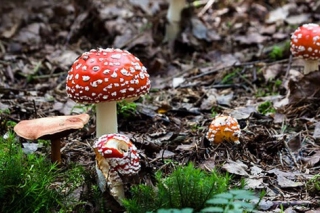





TI: Edible and poisonous mushrooms: an introduction.
AU: Hall-IR; Buchanan-PK; Yun-W; Cole-ALJ
SO: 1998, 189 pp.; 170 col. pl.; 221 ref.
PB: Crop & Food Research; Christchurch; New Zealand
LA: English
AB: After an introductory chapter describing how mushrooms grow, their diversity and nomenclature, one chapter each is dedicated to the cultivation of saprobic mushrooms (including Agaricus bisporus and A. bitorquis, Lentinula edodes, Pleurotus spp., Auricularia spp., Volvariella volvacea, Flammulina velutipes, Tremella fuciformis and Pholiota nameko) and mycorrhizal mushrooms. The remainder of the book is devoted to collection and identification of >200 edible and poisonous mushrooms commonly found in New Zealand and Australia. There is a subject index.
GE: New-Zealand; Australia-
PT: Book
IB: 0-478-10806-0
AN: 980312766
TI: Genetic homogeneity of cultivated strains of shiitake (Lentinula edodes) used in China as revealed by the polymerase chain reaction.
AU: Chiu-SiuWai; Ma-AiMan; Lin-FangCan; Moore-D; Chiu-SW; Ma-AM; Lin-FC
SO: Mycological-Research. 1996, 100: 11, 1393-1399; 55 ref.
LA: English
AB: Nineteen strains, which are used for spawn production in farms throughout mainland China, were characterized by 3 arbitrarily-primed PCR profiles (AP-PCR), 7 RAPD profiles and 5 RFLP patterns of PCR-amplified rDNAs. For AP-PCR, 4-14 DNA bands were amplified for a particular strain while 1-9 DNA bands were amplified using RAPD. Among them only 3 of the strains tested showed different amplification profiles with most of the primers used. The other strains showed small differences in 3 or fewer DNA amplification profiles. All strains showed identical rDNA-RFLPs. The study indicated that cultivated strains of shiitake in China are genetically very homogeneous, a similar situation to that in cultivated Agaricus bisporus and Volvariella volvacea. However, this collection of L. edodes covers an enormous geographical area (?700 km N to S and 700 km E to W) further reinforcing the finding that the shiitake industry in China is based on an extremely small gene pool. In comparison, 3 wild strains collected in Fujian, SE China showed more variable amplification profiles.
GE: China-; Fujian-
PT: Journal-article
AN: 971602382
TI: Mushrooms and truffles.
AU: Singer,-R; Harris,-B
SO: 1987, Ed. 2, 389 pp.; 17 pp. ref., many pl. Koenigstein, German Federal Republic; Koeltz Scientific Books.
LA: English
AB: The first part of the book was written by Rolf Singer and is based on the first edition. Titles of its 13 chapters include the following: Botany of mushrooms and truffles; Botany of the cultivated white mushroom and other cultivated species of Agaricus; Cultivation of Agaricus bisporus and related species; The paddy straw mushroom (a variety of Volvariella volvacea) and its cultivation in the tropics; Shiitake and its cultivation in East Asia; Truffles (including Tuber) and the cultivation of truffles in France; Wood-inhabiting basidiomycetes (9 species described) and other earth-inhabiting mushrooms; Weeds and weed fungi (in mushroom beds and truffle sites, and their control); Mushroom and truffle diseases (of cultivated white mushroom, paddy straw mushroom, shiitake and the mycorrhizal basidiomycetes, and their control); Pests; and Mushrooms and truffles for human consumption and other uses (e.g. as animal feed and in pharmacy). An appendix to the book (page 283), written by Bob Harris, is concerned with the developments, improvements and expansion (both commercial and in range of species) in mushroom culture which have occurred in the past 25 years. Its 10 chapters are entitled: Agaricus bisporus; Volvariella volvacea; Shiitake, Lentinus edodes [Lentinulus edodes] (on log and sawdust substrates); Truffles; Wood-inhabiting fungi; Virulence testing of wood-inhabiting fungi; Terricolous and litter fungi; Nutritional aspects of fungi; Medical aspects; and Economic aspects.
PT: Unnumbered-Whole
AN: C531724
TI: Segregation of genotypically diverse progeny from self-fertilized haploids of the Chinese straw mushroom, Volvariella volvacea.
AU: Chiu-SiuWai; Moore-D; Chiu-SW
SO: Mycological-Research. 1999, 103: 10, 1335-1345; 58 ref.
LA: English
AB: The electrophoretic karyotype of the Chinese straw mushroom, Volvariella volvacea, was determined. The haploid strain V34 of V. volvacea has 15 chromosomes ranging in size from 1.4 to 5.1 Mb. No chromosomal polymorphism in terms of size and number was seen in either of 2 growth stages: vegetative mycelia or fruit-body gill tissues. DNA fingerprints were prepared by the arbitrarily-primed polymerase chain reaction. Those obtained from different stages during fruit-body morphogenesis were identical. However, variation in DNA fingerprints was evident in protoplast regenerants derived from the same vegetative mycelium. Thus the haploid mycelium of strain V34 is heterokaryotic but the bulk genotype is stable during fruit-body development. F1 and F2 progenies germinated from the haploid, uninucleate basidiospores from self-fertilized fruit bodies also regularly segregate a range of mycelial morphological variants as well as phenotypic variation revealed by DNA fingerprints. The known mechanisms that generate genetic variation are reviewed and a novel mechanism that could account for the 1:1 segregation ratio of self-fertile to self-sterile progeny regularly obtained from selfed V. volvacea fruit bodies is proposed.
PT: Journal-article
AN: 19991613591
TI: Non-wood forest products of Manipur State: wild edible fleshy fungi found in the forests and markets.
AU: Singh-NI; Singh-TC; Varma-RV (ed.); Bhat-KV (ed.); Muralidharan-EM (ed.); Sharma-JK
SO: Tropical-forestry-research:-challenges-in-the-new-millennium.-Proceedings-of-the-International-Symposium,-Peechi,-India,-2-4-August,-2000. 2001, 247-250; 15 ref.
PB: Kerala Forest Research Institute (KFRI); Peechi; India
LA: English
AB: The topography and agro-climate of the Manipur State, India provide a conducive condition for the growth of different fleshy fungi. Some of these fleshy fungi are not only edible but have high food value as well as income generating potential for the local tribal inhabitants of the State. Intensive survey of the forests and local markets was conducted in all the districts of the State for two years (1997-1999). Altogether 33 species of wild edible fleshy fungi were collected and identified. The most common species were Auricularia delicata, A. polytricha, A. auricula, Agaricus campestris, Gomphus floccosus, Scleroderma verrucosum, Schizophyllum commune, Lentinula edodes, L. lateritia, Lentinus cladopus, L. tigrinus, L. sajor-caju, Termitomyces eurrhizus [T. eurhizus], T. robustus, T. clypeatus, T. microcarpus, Favolus spatulatus [F. spathulatus], Vascellum pratense, Volvariella volvacea, Tricholoma giganteum [Macrocybe gigantea], Ramaria sp., Pleurotus sp., Lactarius princeps, etc. Sixteen species were found in the markets during March to September. Two genera viz., Auricularia and Schizophyllum were available in the market in dried form throughout the year. The district-wise quantity and market prices are provided. Possibility of large-scale export of commercially important species such as Lentinula edodes (Japanese Shiitake) is envisaged.
GE: India-; Manipur-
PT: Book-chapter; Conference-paper
IB: 81-85041-31-8
AN: 20023156093
TI: Edible fleshy fungi in Rajasthan.
AU: Singh-RD
SO: India, Society of Mycology and Plant Pathology: Symposium on plant disease problems. Indian-Journal-of-Mycology-and-Plant-Pathology. 1978, issued 1979, 8: 1, 78.
LA: English
AB: Podaxis pistillaris, Agaricus bisporus, Pleurotus sajor-caju and Volvariella volvacea.
GE: India-; Rajasthan-
PT: Journal-article
AN: 790377362
TI: Edible mushrooms of West Bengal: III. Volvariella.
AU: Roy-A; Sur-CK; Samajpati-N
SO: Indian-Agriculturist. 1978, 22: 1, 61-63; 3 ref.
LA: English
AB: The characteristics are described of V. speciosa, V. diplasia and V. volvacea.
GE: India-
PT: Journal-article
AN: 800385082
TI: A classification of the stages in the growth cycle of the cultivated paddy straw mushroom (Volvariella volvacea Singer) and its commercial importance.
AU: Samarawira-I
SO: Economic-Botany. 1979, publ. 1980, 33: 2, 163-171; 2 pl., 1 fig.; 15 ref.
LA: English
AB: Pure cultures of the V. volvacea strain CI/70/52 were grown on test tube slants of potato dextrose sugar, and the inoculum was multiplied in large bottles filled with moistened paddy straw. The bottle inoculum was used to inoculate 3 layers of a four-tiered straw bed. The stages in the development of a carpophore were classified on the basis of the time sequence, length, breadth and length/breadth ratio. This classification may be used to provide a basis for harvesting the buttons at the most desirable stage.
PT: Journal-article
AN: 800385276
TI: Other edible fungi.
OT: Andere eetbare paddestoelen.
AU: Schaper-PM
SO: Champignoncultuur. 1983, 27: 3, 127-129; 4 pl.; 9 ref.
LA: Dutch
AB: In this review and discussion on edible fungi other than mushrooms, a list is included of the world production of various species including the following: Lentinus edodes, Volvariella volvacea, Flammulina velutipes, Pleurotus spp., Pholiota nameko, Tremella fusiformis, Auricularia spp., Stropharia spp. and Tuber spp.
PT: Journal-article
AN: 830314823
TI: Abstracts of Papers of the 6th Conference of the Weed Science Society of Indonesia, Medan, 1981.
OT: Kumpulan Abstrak Konperensi ke-Enam Himpunan Ilmu Gulma Indonesia.
AU: Sembiring-EN; Soepardjo-S; Ismail-IG; Ardjasa-WS; Suryatna-E; Abad-RG; Juan-NC-San; Gallego-VC; Mangoensoekarjo; Nurdin; Ronoprawiro-S; Sianturi-W; Susilo-S; Burhan-H; Utomo-IH; Wiroatmodjo-J; Basuki; Soedarsan-A; Eussen-JHH; Zulfadli-M; Tjitrosoedirdjo-S; Suhirman; Munandir-J; Kustyanti-Y; Ansyarullah; Widyanto-LS; Gozali-L; Afwany-M; Yuskardina; Simanjuntak; Ratnadewi-D; Kasno; Zakaria-MA; Soerohaldoko-S; Pane-H; Sundaru-M; Mangoensoekarjo-S (ed.)
SO: 1981, 54 pp.
LA: Indonesian, English
AB: Titles, authors and addresses only are given below in respect of 23 abstracts. P.9. [Study of mechanically preparing Imperata cylindrica land] (E. N. Sembiring, S. Soepardjo) [Inst. Pertanian Bogor]; Pp. 11-12. The prospect of Roundup [glyphosate] application in the preparation of lalang [I. cylindrica] area for food crop production (I. G. Ismail, W. S. Ardjasa, Suryatna E.) [Central Res. Inst. Agric., Bogor]; P. 13. The application of Dowpon M [Dalapon] on alang-alang infested areas, in conjunction with the establishment of food crops (W. S. Ardjasa, I. G. Ismail, Suryatna E.); P. 15. Studies on the control [by glyphosate] of noxious weeds (Cyperus rotundus, I. cylindrica and Pennisetum purpureum) of coconut (R. G. Abad, N. C. San Juan, V. C. Gallego) [Agric. Res. Branch, Philippine Coconut Authority, Davao City, Philippines]; P. 17. C. rotundus control with glyphosate; the influence of mixing urea and herbicides (S. Mangoensoekarjo and Nurdin) [Balai Penelit. Perk. Medan]; Pp. 19-20. The possibility of using glyphosate to control mosses in tea. (S. Ronoprawiro) [Fak. Pertanian Univ. Gadjah Mada, Jogjakarta]; P. 21. Effect of pre-em. herbicides on growth of oil-palm seedlings (W. Sianturi, S. Susilo) [Fak. Pert., Univ. Sumateru Utara, Medan]; P. 23. Experience on alang-alang eradication in PTP XXIII. [PT. Perkebunan 23, Jl. Rajawali 44, Surabaya]; P. 25. A quick method for evaluating herbicide efficacy on Panicum repens L. (S. Ronoprawiro); P. 27. Selectivity of diclofop-methyl in oat (Avena sativa) and sorghum (Sorghum bicolor) (H. Burhan) [BIOTROP]; P. 29. Pyridyloxy phenoxy propionic ester (Fusilade 25 EC) a promising selective herbicide in broad-leaved crops (I. H. Utomo, J. Wiroatmodjo) [BIOTROP]; Pp. 31-32. The effect of shading on the growth pattern of pakis kadal (Cyclosorus aridus) (Basuki and A. Soedarsan) [Balai Penelit. Perk. Bogor]; P. 33. Upland rice-weed competition as affected by nitrogen application and the time and duration of the competition. (J. H. H. Eussen, M. Zulfadli) [BIOTROP]; P. 35. Space occupation in upland rice (I. H. Utomo, J. H. H. Eussen); P. 37. Competition between stylo (Stylosanthes guianensis) and alang-alang (I. cylindrica (L.) Beauv)) (S. Tjitrosoedirdjo, Suhirman, J. Wiroatmodjo, J. Munandir) [Univ. Brawijaya]; P. 39. The effect of light and seed storage on the germination of alang-alang and mile-a-minute [Mikania micrantha] (T. Kustyanti) [Balai Penelit. Perk. Medan]; P. 41. Preliminary trials on the pruning effect on the growth of M. micrantha in different types of soils (Ansyarullah) [Fak. Pert., Univ. Sumateru Utera, Medan]; Pp. 43-44. Translocation of heavy metal into straw mushroom cultured on waterhyacinth media. (L. S. Widyanto, L. Gozali, J. Wiroatmodjo) [BIOTROP]; P. 45. The effects of N, P and K manuring on the growth of water hyacinth. (M. Afwany and Yuskardina) [Fak. Pert., Univ. Sumateru Utera, Medan]; P. 47. Effect of clipping purple nutgrass (C. rotundus) on the content of the tuber. (R. P. Simanjuntak) [Fak. Pert., Univ. Sumateru Utera, Medan]; P. 49. The role of plant pathogens in weed control in Indonesia (D. Ratnadewi, Kasno and M. A. Zakaria) [BIOTROP]; P. 51. Ecophysiological studies on weeds near the kremnophyte orchid Vanda tricolor Lindl. in Cibodas (S. Soerohaldoko) [Pusat Pen. Bot., Lembaga Biol. Nas.-L1P1 d/a Kebun Raya, Bogor]; P. 53. Response of important weeds and rice cvs. IR-36 and Sukanandi to 2,4-D under several levels of N fertilization. (H. Pane; M. Sundaru) [Pusat Penelit. Peng. Tanaman Pangan, Bogor].
GE: Indonesia-
PT: Miscellaneous
AN: 812335848
TI: Proceedings of the 6th Conference of the Weed Science Society of Indonesia, Medan, 1981 (edited by S. Mangoensoekarjo).
OT: Prosiding Konperensi ke-Enam Himpunan Ilmu Gulma Indonesia.
AU: Sembiring-EN; Soepardjo-S; Ismail-IG; Ardjasa-WS; Effendi-S; Abad-RG; San-Juan-NC; Gallego-VC; Mangoensoekarjo-S; Nurdin; Sianturi-W; Susilo-S; Ronoprawiro-S; Haryono-B; Harris-BA; Utomo-IH; Wiroatmodjo-J; Basuki; Soedarsan-A; Eussen-JHH; Zulfadi-M; Tjitrosoedirdjo-S; Moenandir-J; Kustyanti-T; Ansyarullah; Widyanto-LS; Afwany-M; Gozali-L; Yuskardina; Simanjuntak-RP; Kasno; Ratnadewi-D; Zakaria-MA; Soerohaldoko-S; Pane-H; Sundaru-M; Nasution-U; Sanusi-M; Arifin-M; Madkar-OR; Suhargiyanto-K; Wirjahardja-S; Sutrisno; Purnomo-D; Turanto-S; Dekker-RJ; Megia-R; Laumonier-Witjaksana-EK; Veenstra-H; Terry-PJ
CA: Weed Science Society of Indonesia.
Mangoensoekarjo, S. (Editor).
SO: 1981, 290 pp.
LA: Indonesian, English
AB: Full texts of the 23 papers, titles of which are listed in WA 31, 700, are given as follows: Pp. 1-8 [Study of the mechanical preparation of Imperata cylindrica land] (E.N. Sembiring, Siswadhi Soepardjo); Pp. 9-14 [The prospect of Roundup [glyphosate] application in the preparation of lalang [I. cylindrica] area for food crop production] (I.G. Ismail, W. Sabe Ardjasa, Suryatna E[ffendi]); Pp. 15-23 [The application of Dowpon M [Dalapon] on alang-alang [I. cylindrica] infested areas, in conjunction with the establishment of food crops (W. Sabe Ardjasa, I.G. Ismail, Suryatna E[ffendi]); Pp. 25-39 Studies on the control of noxious weeds (Cyperus rotundus L., Imperata cylindrica L. and Pennisetum purpureum Schum.) of coconut (R.G. Abad, N.C. San Juan, V.C. Gallego); Pp. 41-44 [Cyperus rotundus L. control with glyphosate: the influence of mixing urea and herbicides] (Soepadiyo Mangoensoekarjo, Nurdin); Pp. 45-54 [The possibility of using glyphosate to control mosses in tea] (Soedharoedjian Ronoprawiro); Pp. 55-62 [Effect of pre-emergence herbicides on growth of oil palm seedlings] (W. Sianturi, Supratman Susilo); Pp. 63-70 [Experience of alang-alang [I. cylindrica] eradication in PTP XXIII] (Bambang Haryono); Pp. 71-76 A quick method for evaluating herbicide efficacy on Panicum repens L. (Soedharoedjian Ronoprawiro); Pp. 77-82 Selectivity of diclofop methyl in oat (Avena sativa L.) and sorghum (Sorghum bicolor L.) (B.A. Harris); Pp. 83-87 Pyridyloxy phenoxy propionic ester (Fusilade 25 EC) [fluazifop], a promising selective herbicide in broad leaved crops (Is Hidayat Utomo, J. Wiroatmodjo); Pp. 89-96 [The effect of shading on the growth pattern of pakis kadal (Cyclosorus aridus (Don.) Ching)] (Basuki, A. Soedarsan); Pp. 97-108 Upland rice weed competition as affected by nitrogen application and the time and duration of the competition (J.H.H. Eussen, M. Zulfadi); Pp. 109-118 Space occupation in upland rice (Is Hidayat Utomo, J.H.H. Eussen); Pp. 119-132 Competition between stylo (Stylosanthes guyanensis L.) against alang-alang (Imperata cylindrica (L.) Beauv.) (Soekisman Tjitrosoedirdjo, Suhirman, J. Wiroatmodjo, Jody Moenandir); Pp. 133-139 [The effect of light and seed storage on the germination of alang-alang [I. cylindrica] and mile-a-minute [Mikania micrantha]] (Tuti Kustyanti); Pp. 141-149 [Preliminary trials on the pruning effect on the growth of Mikania micrantha H.B.K. in different types of soils] (Ansyarullah); Pp. 151-155 [Translocation of heavy metal into straw mushroom cultured on waterhyacinth [Eichhornia crassipes] media] (Lusianty S. Widyanto, L. Gozali, J. Wiroatmodjo); Pp. 157-165 [The effects of N, P and K manuring on the growth of water hyacinth (Eichhornia crassipes)] (Afwany M., Yuskardina); Pp. 167-170 [Effect of clipping purple nutgrass (Cyperus rotundus L.) on the carbohydrate content of the tuber] (R.P. Simanjuntak); Pp. 171-175 [The role of plant pathogens in weed control in Indonesia] (Kasno, Diah Ratnadewi, M.A. Zakaria); Pp. 177-180 [Ecophysiological studies on weeds near the kremnophyte orchid Vanda tricolor Lindl. in Cibodas] (Soetomo Soerohaldoko); Pp. 181-191 [Response of important weeds and rice varieties IR-36 and Sukanandi to 2,4-D under several levels of N fertilization] (Hamdan Pane, M. Sundaru). The following 8 papers were also presented: Pp. 193-210 [Inventory of weeds on a rubber estate in North Sumatra and its relation to weed management] (U. Nasution); Pp. 211-218 [Investigations into the allelopathic effects of 9 common weed species in tea plantations] (M. Sanusi, Mahfud Arifin, Oktap Ramelan Madkar, K. Suhargiyanto); Pp. 219-228 [Weed problems in agricultural development of marginal lands] (J. Wiroatmodjo, S. Wirjahardja); Pp. 229-235 [The influence of jawan (Echinochloa crus-galli L.) against the growth and production of rice IR 36] (Sutrisno, Djoko Purnomo, Turanto S.); Pp. 243-248 Notes on new or remarkable Indonesian weed species (R.J. Dekker); Pp. 249-252 The BIOTROP weed seedling project (R.J. Dekker, R. Megia, E.K. Laumonier-Witjaksana, H. Veenstra); Pp. 253-260 Weed management in developing countries (P.J. Terry).
GE: Indonesia-
PT: Miscellaneous
AN: 822337173
TI: Study on the spore pattern in basidium of Volvariella volvacea.
AU: Li-SX; Chang-ST; Maher-MJ
SO: Mushroom Science XIII. Volume 1. Proceedings of the 13th International Congress on the Science and Cultivation of Edible Fungi, Dublin, Irish Republic, 1-6 September 1991. 1991, 115-118; 19 ref.
PB: A.A. Balkema; Rotterdam; Netherlands
LA: English
LS: French, German
AB: The straw mushroom, V. volvacea, is an important edible fungus of the tropics and subtropics. Results from scanning electron microscopic examination of the hymenium of 239 mature basidia showed that most basidia are tetrasporic or with 4 sterigmata. However, different basidial spore patterns were also found. The possible sources of variation in this primary homothallic fungus are discussed.
PT: Conference-paper
IB: 90-5410-021-4 (set)\90-5410-022-2 (Vol. 1)
AN: 941601227
TI: Differentiating homothallic Volvariella mushrooms by RFLPs and AP-PCR.
AU: Chiu-SW; Chen-MJ; Chang-ST
SO: Mycological-Research. 1995, 99: 3, 333-336; 32 ref.
LA: English
AB: Three cultivated strains of the homothallic mushroom Volvariella volvacea and one cultivated strain of V. bombycina were differentiated by RFLPs and arbitrarily-primed PCR (AP-PCR). Three multilocus RFLP markers were randomly labelled with digoxigenin-dUTP during PCR and Southern hybridized at high stringency with the partially digested DNA mixtures. In both techniques, V. bombycina showed distinct DNA fingerprints but the V. volvacea strains had to be differentiated using more than one marker/primer. Compared to RFLP, AP-PCR was more simple to perform, and allowed easier differentiation of species and strains. The observed highly similar DNA fingerprints may reflect a lack of heterogeneity in commercial V. volvacea strains.
PT: Journal-article
AN: 951606070
TI: Differentiating homothallic Volvariella mushrooms by RFLPs and AP-PCR.
AU: Chiu-SW; Chen-MJ; Chang-ST
SO: Mycological-Research. 1995, 99: 3, 333-336; 32 ref.
LA: English
AB: Three cultivated strains of the homothallic mushroom Volvariella volvacea and one cultivated strain of V. bombycina were differentiated by RFLPs and arbitrarily-primed PCR (AP-PCR). Three multilocus RFLP markers were randomly labelled with digoxigenin-dUTP during PCR and Southern hybridized at high stringency with the partially digested DNA mixtures. In both techniques, V. bombycina showed distinct DNA fingerprints but the V. volvacea strains had to be differentiated using more than one marker/primer. Compared to RFLP, AP-PCR was more simple to perform, and allowed easier differentiation of species and strains. The observed highly similar DNA fingerprints may reflect a lack of heterogeneity in commercial V. volvacea strains.
PT: Journal-article
AN: 951606070